

This piece is part of Essentially Man’s “Men and Sports” series, exploring the lives and experiences of male athletes, the worlds they inhabit and the ways sport shapes men, relationships and male culture. It also sits within the “What It Means to Be a Man” series, long-form profiles exploring how men live, train, work and find meaning across cultures.
The project exists to let men speak for themselves, in a culture that usually speaks about them.
I never saw my dad play rugby.
By the time I came along, that part of his life was already over. I knew he had played, of course, but growing up I knew surprisingly little about it. Dad seldom spoke about his rugby days unless I asked.
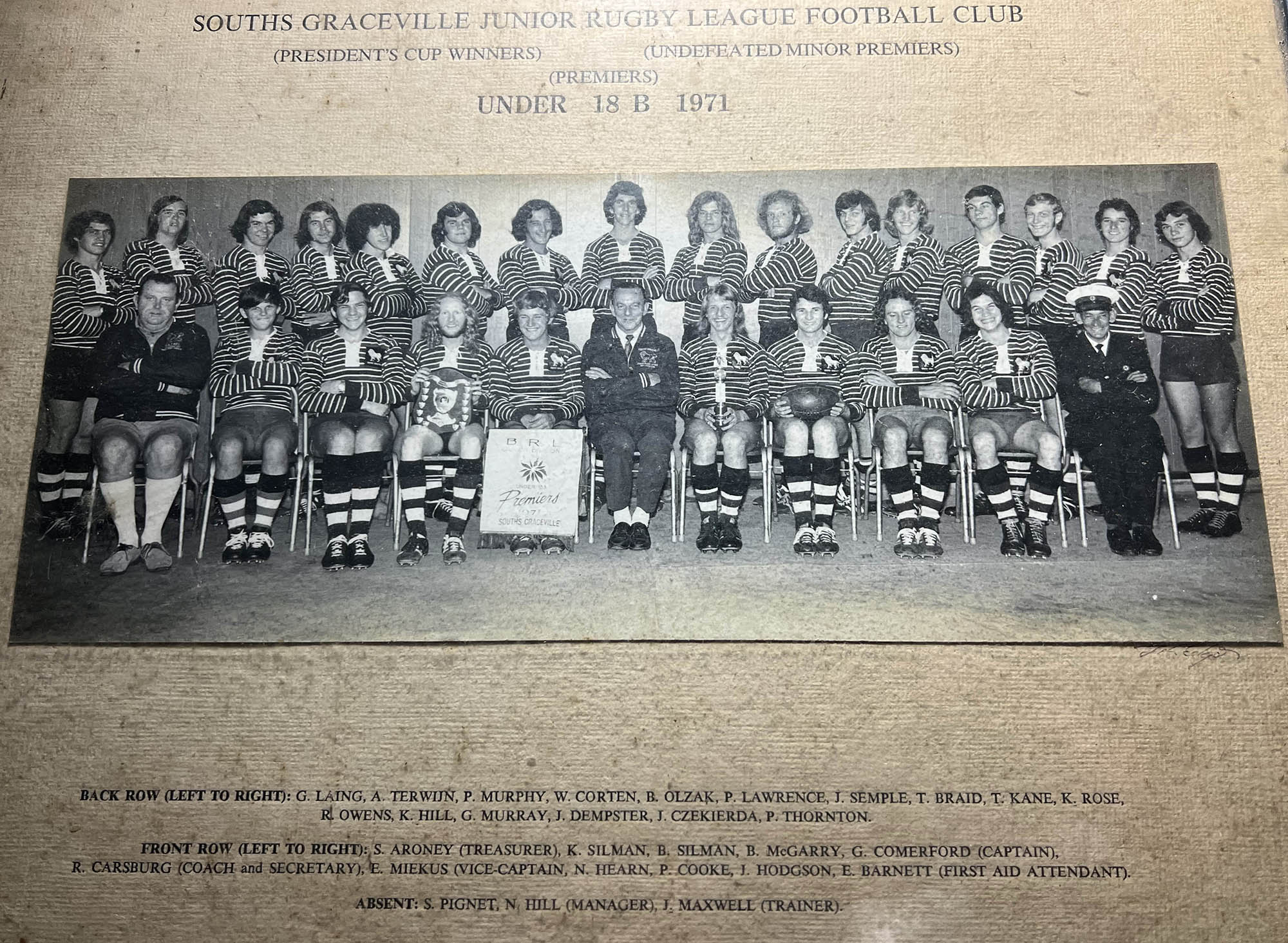
What I had were photographs and the occasional story. One of them is from 1971. Dad is playing for Souths Graceville Junior Rugby League Football Club's Under 18 B side. They were President's Cup winners, undefeated minor premiers and premiers that year. Dad is in the front row, fourth from the left, holding the shield the team had won.
He's hard to miss: long ginger hair falling around a sharp, angular face, his rugby jersey loose over the lean frame he apparently wished carried more muscle. His shorts reveal the thighs he wished were thicker.
Years later I started asking questions.
“Rugby was a group of mates playing together for one purpose, each one with a different job to play in the team. It was a similar way to the workplace because it taught you to work with others,” Dad says.
Dad wasn't a big man, although his low centre of gravity helped. What comes through most when he talks about rugby, though, is that he enjoyed himself.
“I enjoyed the running, the feinting on the field, the bit of roughhousing,” he says.
I suspect I've thought more about what rugby meant to Dad than Dad ever did while he was actually playing it. When I ask about sport and its place in his life, I get a fairly typical Dad answer.
“I just loved sport for its own self. I had mates in footy”.
There wasn't much more to it, at least as far as he is concerned.
Rugby, work and taking the knocks
Dad does think rugby taught him things he used elsewhere. Teamwork was one. Training was another.
“The training and motivation needed to train and play no matter the weather or state of health did, I believe, give me more or add to the personal strength I needed to deal with my health issues,” he says.
Dad was eventually diagnosed with osteoarthritis, which has left him living with chronic pain.
“You learn to take the knocks and the bumps not just literally but emotionally as you go through life,” he says.
I can recognise that in him.
Dad has always had a capacity to deal with whatever is in front of him and get on with it, which makes it difficult for me to know where rugby fits. Perhaps rugby strengthened something that was already there. Dad thinks it did, particularly when his health started giving him problems. I can't really know. He can.
What I do know is what happened when he couldn't play anymore.
“I was a bit lost; football was my life,” he admits.
He eventually took up touch football rather than giving sport away completely.
“The training and motivation needed to train and play no matter the weather or state of health ... gave me the resilience to pick myself up and go another way,” he reflects.
Dad
The father I grew up with was emotionally reserved. Very emotionally reserved.
It could be frustrating.
Dad showed affection through what he did for us but as a kid, and even as an adult, sometimes you just want your father to say something. I was nearly 30 before I heard him say “I love you”.
I remember it because Dad didn't say things like that.
For a long time I saw his silence mostly as distance. I understand it a little differently now, although I'm wary of making excuses for him simply because he's my Dad and I'm older. There were things I wish he'd said. There still are.
His rugby years were another silence of sorts, although I don't think he deliberately kept them from me. They were simply over by the time I was born and he wasn't somebody who sat around reminiscing about himself.
So I had to ask.
The answers were simpler than I expected. Dad loved the physicality of rugby: the running, the feinting, the roughhousing. He liked being part of a team. He had mates there. When he couldn't play anymore, it left a hole. Eventually he found touch football.
That feels closer to Dad than trying to turn his years on a rugby field into some grand explanation of how he became a man.
What was passed on
Dad never sat me down to explain resilience or work ethic. I learned more by watching him. A silent education, I suppose.
I watched him get on with things when he was unwell. Osteoarthritis has left him in chronic pain but I've watched him get out of bed on days when plenty of people probably wouldn't, then go outside and mow the lawn. Often he'll do part of the neighbour's yard while he’s at it, simply because it's there. Complaining hasn’t really been his style.
There are things about his emotional reserve that have frustrated me, but there are other things I've absorbed simply by being around him.
I recognise some of them in myself now.
He spoke about every player having a different job but working towards the same purpose. That carried into the way he thought about work.
He spoke about training when the weather was bad or he wasn't feeling great. Later, when his own health caused problems, he kept doing what he could.
And when rugby became impossible, he played touch.
Even now, if I'm unwell or something has gone wrong, my instinct is usually to work out what still needs doing and get on with it. I know where some of that comes from.
Maybe some of that came from sport for Dad. He thinks some of it did and I'll take his word for it.
But rugby wasn't secretly preparing him for every difficult thing that happened later. Sometimes a game is a game. Dad himself is quite clear about why he played.
“I just loved sport for its own self. I had mates in footy”.
I like that answer more the older I get.
But I wonder about that now, particularly when so much is written about men being lonely or lacking close friendships. Dad wouldn’t necessarily describe rugby as an answer to any of that. He played because he liked playing and because his mates were there.
Nobody had to organise a conversation about friendship or belonging. A group of men turned up several times a week, trained together, played together and relied on each other to do their job. His mates were simply part of playing football. Maybe that's why his answer interests me so much now.
A part of him I missed
There are things I'd like to know that I probably never will.
I'd like to have seen Dad play. I'd like to know what he was like with the other men when I wasn't around, particularly when he was young. Was he as reserved with his teammates as he later was at home? Did he talk more in the changing room than he did around us? Was he funny? Loud? Did he give people shit? Did they give it back?
I don't know.
The photographs don't tell me much beyond what he looked like. His answers to my questions are usually brief because that's how Dad answers questions.
Maybe that's partly why I've spent so much time trying to understand him.
Rugby gave me another bit of the picture. It introduced me, rather late, to a young man who liked running, feinting, roughhousing and playing football with his mates. A man who was apparently devastated when his body told him he couldn't do it anymore.
I knew what came afterwards.
I just wish I'd seen the bit before.
Essentially Man documents how men live, not how they should.